Life is There
The documentary Life Is There chronicles the director’s wanderings through the streets of Cairo, weaving together Egypt’s past and her own life story, shaped by displacement in the wake of political events. In this text, filmmaker Ishtar Yasin Gutiérrez describes how the film came into being.
I set out into the streets of Downtown Cairo. The starting point was to wander aimlessly—to walk with an open heart, at random, free from clocks and time. I had no script, or any statement. I did not want to begin the film with written, rational language, nor with an explanation or a preconceived concept. I also chose not to imagine scenes or devise a shooting schedule. Words would emerge once the images and sounds already existed. I wanted reality to surprise me, to reveal various temporal dimensions, non-linear, and to write directly through images and sounds, with a language that only belongs to the cinema.
The filming process was fragmented, spanning three trips, over three years, where I wanted to spontaneously capture the rhythm of the city, its ancient past and the traces that still linger on its streets and walls. Memories would surface unexpectedly, intertwining with the present reality, where the sound environment constantly transformed the images.
This film didn’t receive any fund; it was not supported by any film labs, residencies, development programs, or markets. It was driven, above all, by an unwavering desire to bring it into existence, at any cost.

I make my living primarily as a teacher, and through great personal sacrifice, I managed to scrape together a minimal budget for each trip to Cairo. As the filmmaker, facing the impossibility of hiring a crew, I also took on the roles of producer, cinematographer, sound recordist and editor. Consequently, with my savings, I chose to support the people who appeared in the film.
These economic constraints and the specific conditions under which I filmed became an integral part of the film’s aesthetic. I wanted to break free from a system that dictates the creative process, allowing myself the liberty of having the flexibility to pause and reflect, interrupt, extend, or reshoot.
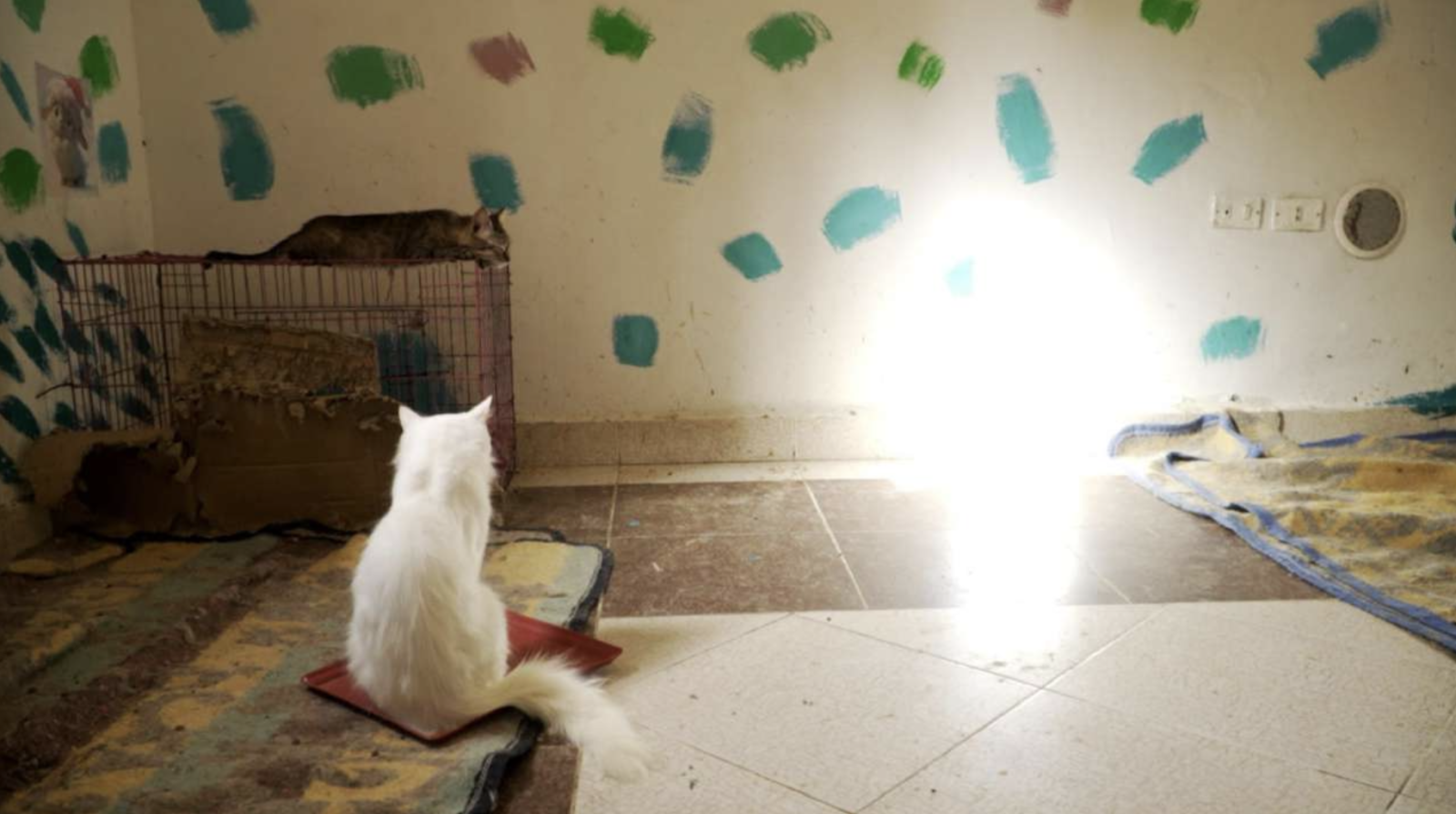
Thanks to this film, I met extraordinary people who dedicate their lives to feeding stray dogs and cats—people for whom animals are fellow inhabitants of a humanity still capable of tenderness.
I also met a music teacher who played an imaginary piano and accordion, and a muralist from the era of the so-called "Arab Spring."
And it was during this filmmaking process that we witnessed—through our phone screens—the suffering of a people being annihilated in their own land. Carrying a suitcase full of toys, I wanted to reach out to those families and embrace the children of Gaza, Palestine. I had the privilege of hearing their voices, looking them straight in the eye, and discovering their paintings.
“Creating a film is like building a home, with its nooks and labyrinths—a home with open windows where viewers can enter and wander.“
My family and I fled two dictatorships: Pinochet’s in Chile and Saddam Hussein’s in Iraq. I was a child then, and I can understand and empathize with those forced to leave their country against their will. The exiles, the uprooted, those torn away from their land, their families, and their pasts; those who sustain themselves with floating roots.
This blend of Arab and Latin American cultures has led me to make films that connect East, West and South. I want to show a different image, opposite to the biased view spread by mainstream media. To me, creating a film is like building a home, with its nooks and labyrinths—a home with open windows where viewers can enter and wander.
Life in Cairo led me to look within myself and revive lost dreams; the city acted like a mirror revealing my own condition. I knew these images would become a film when reality began to transform me. That meant the film, too, could transform the audience.
I discovered the structure of “Alhaia Hunak” (Life Is There) during the editing process, and that became a ritual act, as if I were listening, following, and creating music. In this way, I uncovered the threads connecting these fragments of life, with social and political realities, and with personal, intimate moments. Time was a spiral in which the present constantly reconnected with the past.
“Today,” says writer, anthropologist, and activist Rita Segato, “we have entered a new era where injustice is displayed without shame.” Creation is an act of resistance, and it is necessary to move away from the dominant models that dictate how we create. To let tenderness persist despite destruction. It is about shedding light on those living on the periphery, on the margins, the edges, the fringes. The purpose is, above all, to safeguard our humanity.
I want to return to the “traveling cinema” and to take a screen to villages, neighborhoods, parks, streets, and to project this film under the stars, because “life is there.”